
Key Takeaways
- Concentrated stock conversations can be difficult to move forward when advisors lack a clear, scenario-based way to communicate risk, tax exposure, and potential paths forward.
- Manual workflows can create a bottleneck through statement data entry, piecemeal analysis, and presentation assembly.
- A structured workflow separates data intake and analysis from presentation assembly, helping ensure the analytical foundation is established before client-facing materials are created.
- Firms can make these workflows more repeatable by standardizing the analytical and presentation process, giving advisors a more consistent, governed toolkit without dictating their advice.
- Technology can help advisors move more efficiently from raw data to a client-ready deliverable, allowing more time for the conversation itself.
An ideal prospect walks through the door, holding a seven- or eight-figure concentrated stock position. As an advisor, you immediately recognize the idiosyncratic risk and can name a half-dozen diversification strategies that could apply. Yet concentrated-stock conversations can be complex. Advisors may need to communicate concentration risk, embedded gains, tax considerations, and potential scenarios clearly while working with data spread across multiple statements and accounts. When preparing that analysis requires significant manual work, the workflow itself can become another source of friction.
Several factors can make these conversations challenging, including the significance a prospect may attach to a concentrated holding, the complexity of evaluating tax considerations, and the difficulty of presenting clear, objective analysis in a format that supports discussion.
One potential bottleneck in converting a concentrated stock position is the analytical and presentation workflow that sits between raw portfolio data and a client-ready deliverable. This is not a guide to diversification strategies; it is an operational look at how advisory firms can build a faster, more consistent process for preparing for and presenting concentrated stock analysis.
Why Concentrated Stock Conversations Stall
It can be easy to focus on client hesitation alone, but the preparation and presentation workflow is another factor worth examining. When analysis is prepared manually or inconsistently, the materials may not fully support a clear, confident discussion. In many cases, the conversation becomes more difficult because the advisor must navigate several layers of complexity at once.
One factor is the significance a concentrated holding may carry for the investor. For some investors, a concentrated equity position may have financial or personal significance beyond its current portfolio weight. Scenario-based analysis can help frame the conversation around forward-looking risk alongside historical performance.
Another factor is tax complexity without sufficient clarity. A prospect may understand that reducing a concentrated position could have tax consequences, but not yet have a quantified view of the tradeoffs involved. Without a scenario-based analysis showing the after-tax implications of different approaches, it may be harder for a prospect to evaluate different paths.
A third challenge is the presentation itself. An advisor might perform thoughtful analysis in a spreadsheet, but if the output delivered to the prospect looks like internal work product, it may be more difficult to communicate the analysis clearly and consistently. Consider an illustrative scenario: an advisory team takes over a week to assemble a concentrated stock analysis from PDFs and spreadsheets. During the presentation, they discover a cost-basis data entry error that undermines the tax-impact narrative. Cases like this illustrate how manual preparation workflows can introduce errors or delays into the client experience. The prospect may have heard a diversification discussion before. What can make the difference is a presentation that helps organize the risks, tradeoffs, and considerations in a clear and objective way.
Read more: How to Create Winning Proposals: 3 Tips for Advisors
What a Structured Analytical Workflow Looks Like
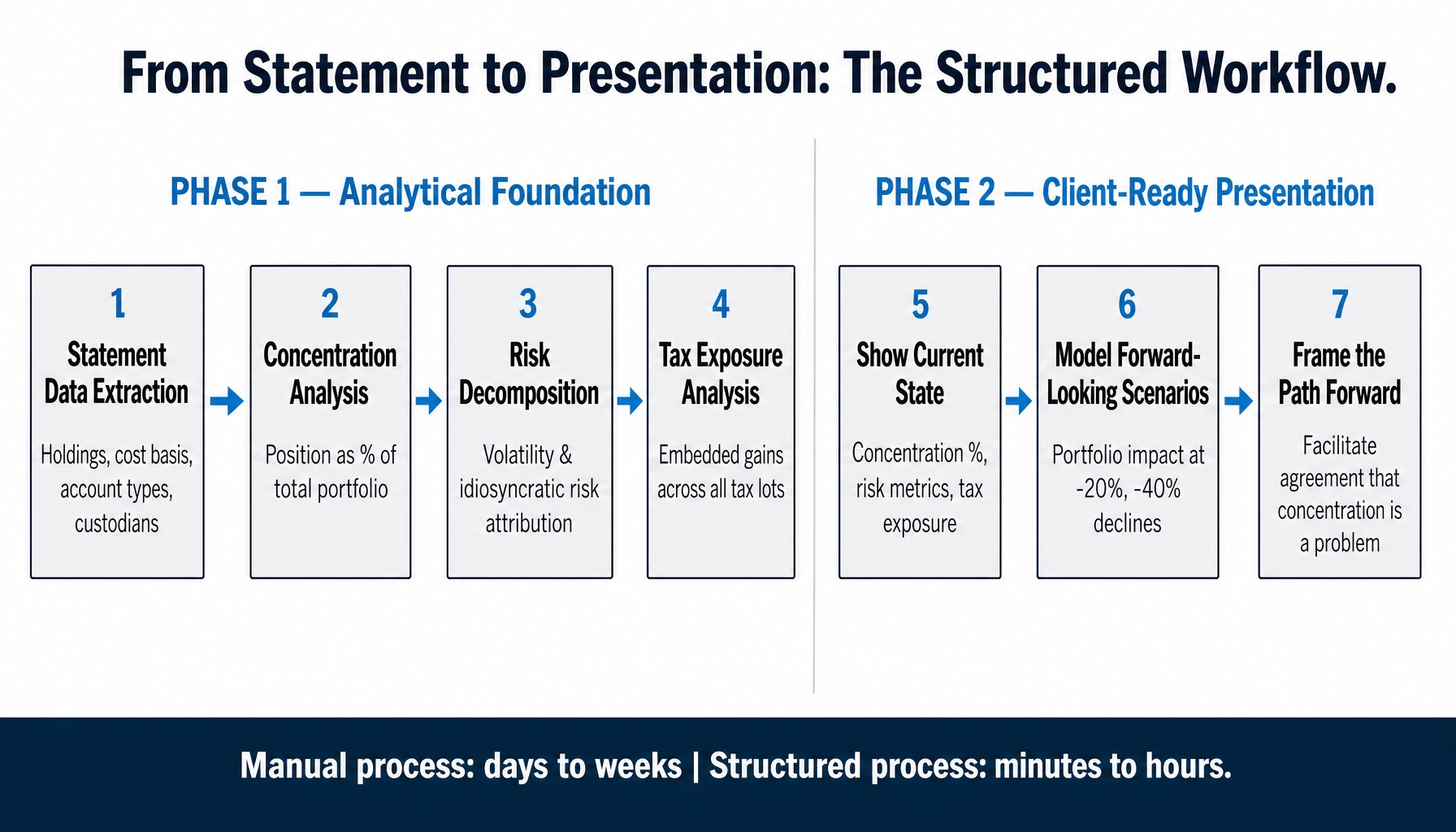
The quality and speed of the analytical workflow can influence how effectively an advisor prepares for the conversation. A structured workflow turns a bespoke, high-friction process into a repeatable discipline. It has two distinct phases: first, building an analytical foundation from raw data, and second, assembling that analysis into a client-ready presentation. When firms handle these steps manually, delays, inconsistencies, and opportunities for error can follow.
A disciplined workflow moves from statement to presentation with intention, helping the advisor focus more of their time on the client and less on the clerical work of preparation.
From Statement Data to Analytical Foundation
The workflow begins the moment an advisor receives one or more investment statements. The immediate challenge is extracting structured data holdings, cost basis, asset allocation, account types, custodians from those documents. Manual extraction and reconciliation can require significant preparation time, and errors in holdings or lot-level data can affect downstream analysis.
Once the data is structured, the actual analysis can begin. This is not about picking a strategy; it is about establishing an objective baseline. The foundational analysis should include:
- Concentration Analysis: What percentage of the total portfolio does the single position represent?
- Risk Decomposition: How much of the portfolio's volatility and idiosyncratic risk is attributable to that one holding?
- Tax Exposure Analysis: What are the embedded gains across all tax lots?
- Fee and Performance Review: What are the existing costs and historical performance metrics?
Establishing a reliable analytical foundation before moving into strategy discussions can help create a clearer starting point for the conversation. When analysis is assembled piecemeal across multiple tools, the process can slow down and become harder to standardize.
From Analysis to Client-Ready Presentation
This phase focuses on translating the analytical output into a format the prospect can understand and discuss with the advisor. The gap between what the advisor sees in a spreadsheet and what the prospect sees in a meeting often shapes how clearly the analysis comes across. In a concentrated stock portfolio presentation, consistent assumptions, clear visual hierarchy, and transparent presentation of tradeoffs can make complex analysis easier to understand.
A strong presentation for a concentrated stock position needs to accomplish three things clearly:
- Show the Current State Objectively: Present the concentration percentage, risk metrics, and tax exposure with clean, professional visuals.
- Present Forward-Looking Scenarios: Model relevant downside or concentration scenarios based on the firm's methodology and the client's circumstances.
- Frame the Path Forward: The goal is to help the prospect understand the concentration, associated risks, and relevant considerations so they can have a more informed discussion with the advisor.
The final deliverable can be designed to clearly communicate the analysis while aligning with the firm's branding and applicable compliance requirements. When advisors build these slides manually, the output may look different every time, and the firm may have less operational visibility into what was presented. This manual assembly can also become a source of delay and inconsistency in the preparation process.
Making the Workflow Repeatable Rather Than Bespoke
When firms treat each concentrated-stock analysis as a one-off project, the process can become harder to scale as volume increases. The advisor builds the analysis from scratch, assembles the presentation manually, and the workflow may differ from one case to the next. This can create variability in both preparation time and the final client-facing deliverable, especially when diversifying concentrated stock becomes a more frequent part of the firm's growth strategy.
Consider an illustrative firm with four advisors, each handling these conversations differently. One uses a complex spreadsheet model they built years ago. Another outsources the analysis to a third-party service and waits days for the output. A third builds slides in PowerPoint with no standardized template. A fourth uses a basic proposal tool that cannot handle multi-lot tax analysis. The firm's leadership has no visibility into what is being presented, no way to ensure consistency, and no easy way to compare which approach is actually working. From a governance perspective, firms may want visibility into scenario assumptions, disclosures, and whether presentations align with approved methodologies.
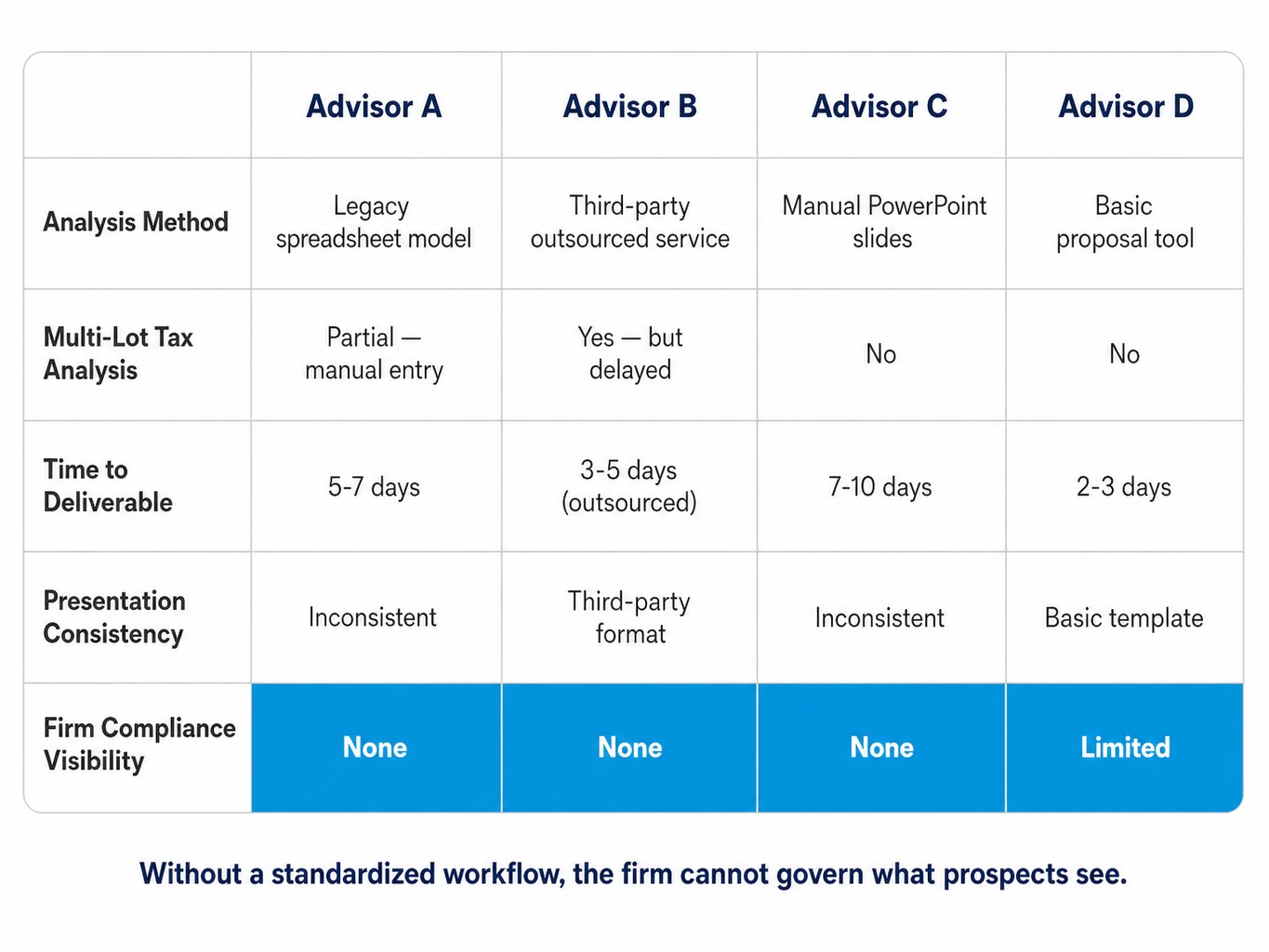
Firms may benefit from standardizing the workflow infrastructure at the firm level. This does not mean standardizing the advice or removing advisor judgment. It means giving every advisor the same analytical foundation and presentation infrastructure. A repeatable workflow ensures that every analysis starts with clean, structured data and flows into a firm-approved, branded presentation template. This allows the advisor to focus on the nuances of the client conversation while working within a consistent analytical and presentation framework. It turns a bespoke art project into a more scalable, governable business process.
Read more: How to Scale a Financial Advice Practice: 6 Steps to Compound Capacity Without Burning Out
How VRGL Supports the Concentrated Stock Acquisition Workflow
A key challenge in concentrated stock conversations is the need for fast, objective, scenario-based analysis presented in a professional format that a prospect will trust. Manual preparation processes can create friction when they are slow, inconsistent, or prone to error. As a Growth Platform for wealth management firms, VRGL is designed to help address this tension by providing a configurable system of work that connects data intake, analysis, and proposal generation into a repeatable, governed sequence.
The process mirrors the structured workflow this article describes. It begins with VRGL Statement Extraction , which uses proprietary AI to convert multi-custodian statements into structured, analyzable data, reducing manual data entry and the potential for transcription errors.
From there, VRGL Core provides objective analytics to surface concentration risk, decompose portfolio volatility, and model tax exposure across multiple lots and accounts. Instead of piecing together analysis from different tools, advisors have a single, objective foundation.
Finally, VRGL turns that analysis into a white-labeled, client-ready proposal . The platform generates a branded, client-ready presentation that can support firm compliance and presentation standards. It helps advisors communicate current-state analysis and relevant scenarios clearly. For enterprise firms , this entire process can be governed with controlled templates and firmwide visibility, supporting greater consistency across advisors and offices.
VRGL helps advisors spend less time preparing the analysis and more time in the conversation where their expertise actually matters.
See how VRGL supports the concentrated stock acquisition workflow request a demo .
From Workflow Gaps to Repeatable Growth
Concentrated-stock situations can be analytically complex, especially when advisors are working across multiple statements, accounts, tax lots, and presentation requirements. A repeatable workflow can help advisors move more efficiently from raw portfolio data to clear, consistent client-facing analysis. It can also support a more standardized preparation process across the firm.
Rather than treating each concentrated stock position analysis as bespoke project work, firms may benefit from building workflow infrastructure that supports consistency, efficiency, and clearer communication. That kind of operational foundation can make it easier to prepare objective analysis and deliver it in a format that is ready for discussion.
Frequently Asked Questions
At what portfolio percentage is a stock position generally considered concentrated?
There is no single universal threshold for when a position is considered concentrated. The answer depends on the client's broader balance sheet, liquidity needs, diversification across the rest of the portfolio, and the role that holding plays within the overall investment picture. Evaluating concentration in context is generally more useful than relying on a single percentage alone.
Why do prospects with concentrated positions often meet with multiple advisors before acting?
Concentrated-stock decisions can involve multiple layers of complexity, including portfolio risk, tax considerations, liquidity needs, and personal circumstances. In some cases, prospects may seek several perspectives before deciding how they want to proceed. Clear, scenario-based analysis can help support a more informed discussion during that process.
How does multi-custodian complexity affect concentrated stock analysis?
When assets related to a concentrated stock position are spread across multiple custodians or account types, the analysis may require a more complete view of holdings, cost basis, and account structure. Consolidating that information manually can add preparation time and increase the need for careful reconciliation before presenting the analysis.
Can the initial presentation to a concentrated stock prospect be separated from specific strategy recommendations?
One approach firms may consider is separating the diagnostic analysis from specific strategy recommendations. The initial conversation can focus on helping the prospect understand current concentration, portfolio risk, tax exposure, and other relevant considerations before moving into a more strategy-specific discussion.
How do firms ensure compliance consistency when multiple advisors present concentrated stock analysis?
When multiple advisors prepare materials independently, firms may have less centralized visibility into what is being shown to prospects. Standardizing the presentation workflow through governed templates, required disclosures, and centralized oversight can support more consistent governance and oversight without dictating an advisor's specific recommendations.
VRGL is a technology platform for financial advisors and is not a client-facing investment adviser. VRGL does not provide investment, financial, tax, or legal advice and does not make investment recommendations. The information provided herein is for informational and educational purposes only and is not intended to be, and should not be construed as, an offer to sell or a solicitation of an offer to buy any security or to participate in any investment strategy.